A note to my readers:
A long time ago, I published a blogpost in which I referred to myself as “sort of” white. I got an inordinate amount of feedback, both positive and negative, some just curious, some weirdly aggressive, about my use of “sort of” in that context. In an attempt to unpack that phrase, I continue to share my experiences of being “white-ish” in various blogposts, including this one, as they are relevant to my ethnic identity.
Today marks a year since Hamas’s deadly attack against Israel. A year since the start of Israel’s even more deadly, even more horrifying, even more barbaric attack against my people – in Gaza, yes, and in the West Bank, too. And if you’re not aware of that piece of it, then you need to broaden your news sources.
There is grief, yes. So much grief. So much grief, in fact, that when I learned yesterday that my uncle in Jordan died of natural causes, the added grief barely registered. As crass as that sounds, it’s true. He was a beloved and good man. And it is not fair to him or to his family that I cannot mourn him fully, rightly. But when you are carrying an ocean of grief inside yourself all day every day for a year, how do you mark one more drop?
And there is anger, too, of course. So much anger at the injustice of it all – the ongoing injustice, the unceasing injustice – from every direction: from crazed Bibi to Western media to Biden and Trump and Harris with their cruelty in word and inaction.
But, today, what I’m feeling most is neither of those powerful emotions that I have carried within my body for the past twelve months. Today what I’m feeling most, what has undone me, what has reduced me to wracking sobs is the exhaustion.
I am just so very tired.
I am tired of carrying the grief and anger, unable to take a break, for every day brings new reasons for them both.
I am tired of the constant effort of separating my mind into two compartments, and keeping the door of the grief and anger firmly shut 90% of the time so that I can continue to parent my children well and love my husband and do my actual paid job. So that I can function as a normal-looking human being in this blessed life I lead.
I am tired of the energy it takes to not compare griefs. To not do the obvious math between the 1200 murdered on Oct. 7 and the more than 40 times that number murdered since Oct. 8. To listen to the NPR stories on this day about Jewish new year and sadness and not harden my heart, to insist to myself that I listen to their pain.
I am tired of keeping a rein on my righteous anger that we as a global society have become so callous as to value human beings differently depending on their nationality, on their religious and ethnic identities. The effort of refraining from burning it all down exhausts me.
I am tired of frantically, desperately searching for hope and grace in the smallest moments of my life and sucking every last drop of it from every possible second. Every day, I take the grace that comes to me – in the form of a text from a friend who checks in or the love of my PACA colleagues or the random but positive encounter with another mom on the soccer field – and lick the hope from it clean, like a thirsty woman in a desert who finds a thimbleful of water.
But here’s what exhausts me the most: it is the work of educating others. And I know I don’t do it alone. But, God, it feels like it sometimes. And it’s not the actual education part. It’s not like telling my story is in itself exhausting. On the contrary, to tell the story is life-giving; it is the legacy my grandmother gave to me and it is my joy and my deep privilege to tell it.
But it’s never to a plainly curious audience. If only. I tell my story because so many people do not know it. And they say and do hurtful and offensive things from their place of ignorance. And it is always, always my job to meet them in their ignorance with the grace and empathy that they are unable to have for me, to tell them my story, and to bring them, step by step, along a path to greater understanding. It is my job to refrain from lashing out in anger from the place of my pain and instead to offer only kind words. It is my job to finesse the truth I have to tell into a language that they can hear. And it is exhausting.
When I’m lucky, someone finds me a larger audience – and that is a gift. It eases the burden to know that my efforts can impact ten or twenty or forty people at a time in a room or a Zoom, and when I am paid for those efforts, which I have been some this year, I am immensely grateful.
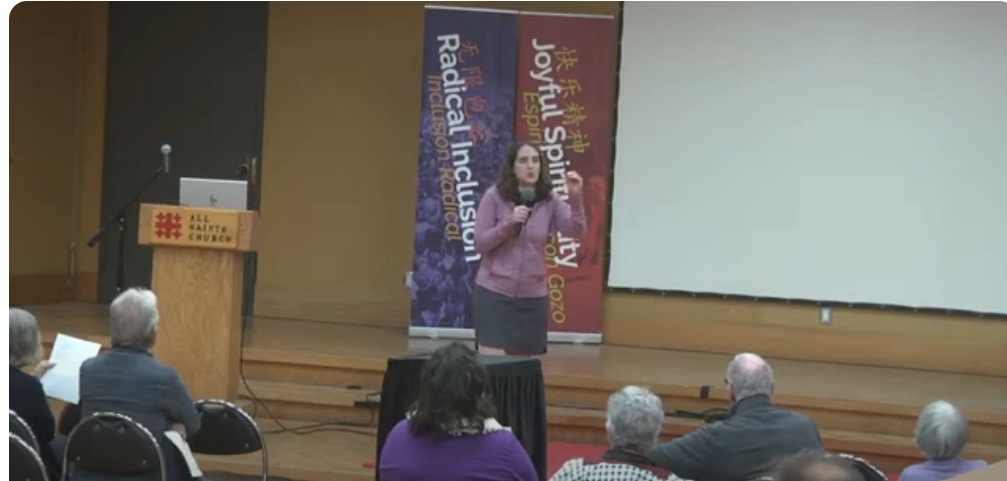
But so much more often, this work is on a one-on-one basis. It is responding to the email of a colleague who is deeply misguided. It is the conversation on the phone with a friend who wants to learn more so that she can be a good ally (thank God!). It is receiving a cruel message in response to an essay on my blog or a post on my social media and replying with an invitation instead of anger. It is subtly but consistently reminding those few in positions of power with whom I have relationship that they must not forget.
And to do all of that, I have to make myself vulnerable, expose myself to the potential of further harm and pain, allow the firmly shut door that compartmentalizes it in my brain to open just enough – but not too much – to tell the story without unleashing all the passions and emotions that go along with it.
And it is exhausting me.
But I cannot stop. I must not stop. And this is where my whiteness convicts me. Because I am free to speak. I am free to do this work. I have the immense privilege of American citizenship that prevents any real harm threatening me. I have the immense privilege of my clergy collar that provides an authority that few others have in this Christo-centric culture. I have the immense privilege of my unaccented English, unlike my aunties and uncles, of my white, white skin, unlike so many of my cousins, that grant me the power to be taken seriously, to not be immediately dismissed.
And I know that such privileges demand that I take up their corresponding responsibilities: to speak, to educate, to hold out grace. Even when doing so exhausts me.
“If anyone would come after me,” says Jesus, “let her deny herself and take up her cross and follow me.”
How well I understand his meaning after this horrific year. Finally, I see what it means to spend of yourself, to drain yourself, to deny yourself for the sake of others. This work has become my cross to bear this year. I pray for the strength to continue to carry it.
Jesus also says: “Come to me all you who are weary and heavy-laden and I will give you rest. For my yoke is easy and my burden is light.”
I long for that rest. I hold on to the faith that what Jesus says is true. But today, today, right now, this moment, I am struggling to believe it. This yoke does not feel easy; this burden is anything but light. I am overcome by it.
And yet I cannot put it down.


 The Thankful Priest - Leyla King
Leave a comment