A few weeks ago, I posted these words on my Facebook page:
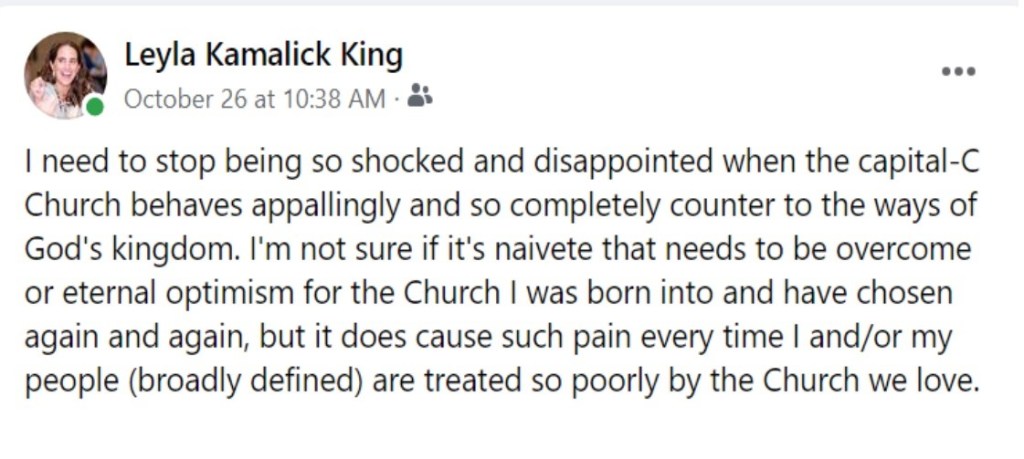
I wrote those words immediately after a conversation with someone on a diocesan staff where I felt like I was being gaslit.
I also wrote them after spending weeks as a Palestinian Episcopalian who, even as a clergyperson, is completely unseen, at best, and painfully betrayed at worst by the Episcopal Church – by its systems and many of its people in power.
I also wrote those words after spending the past four years healing from the trauma of being discriminated against based on my race and gender by an Episcopal institution and experiencing a kind of cancellation of my very self in the “good ol’ boys” network that the Episcopal Church still exemplifies in many ways.
They were honest words. And they are a true reflection of my experience of the way many people in power in The Episcopal Church operate. The capital-C Church can be so very hurtful.
But you know what? This is also true:
Since Oct. 7, I have had members of The Episcopal Church reach out to me through every kind of medium. There have been Facebook messages and comments, texts and emails, phone calls and invitations to Zoom meetings. There have been friends and acquaintances of every order of The Episcopal Church – lay people, deacons, priests, bishops – who have checked in with me or my family to ask how we’re doing, who have come alongside me with compassion and kindness. I have heard from at least one person – usually many more – from every institution or community within the Episcopal Church of which I have ever been a part (and even one in which I am considering being a part!), from my childhood parish to the cathedral that sponsored me for ordination, from my network of Episcopal clergywomen to the friends who make up the Small Churches Big Impact Collective, from my dearest Thankful Ones to my old neighbors in Sewanee. Thanks to members of all these communities, I have been shown that I – and my people – are not forgotten. So many Episcopalians from so many parts of my life have told me that I am on their hearts and in their prayers, that I am seen, that I am loved.
And all those connections have led to even more wonderful connections: clergy colleagues who are eager to partner and collaborate with me in the work of education and advocacy, directors and officers of various organizations within The Episcopal Church’s umbrella who want to center my voice, new friends of Palestinian or Arab or Asian descent and other Episcopalians of Color who offer empathy in a time of isolation, love in the face of the threat of desolation.
And here’s what I keep reminding myself: this, too, is the Church. The capital-C Church.
Most of them don’t wear purple shirts – indeed, only a few of them do. But these people are the Body of Christ. They count as Church just as much as the bishops and the folks who hold power in the institutional hierarchy do. In fact, I think they count more than that hierarchy. When Jesus calls us to be the ekklesia together, to live together and love together as one gathering, as one people united in His name, it is a call to connection, to concern oneself with all members of His body. And I have experienced that so very profoundly in this past month. And it has gone a loooooong way towards helping to heal the hurts that that the other capital-C Church has inflicted.
And in the end, are they one and the same? Can the kingdom of God be revealed in this institution that, in the course of just a few weeks, has both deeply traumatized and profoundly nourished me? It doesn’t seem possible, honestly. But I think it is nonetheless true.

 The Thankful Priest - Leyla King
Leave a comment