
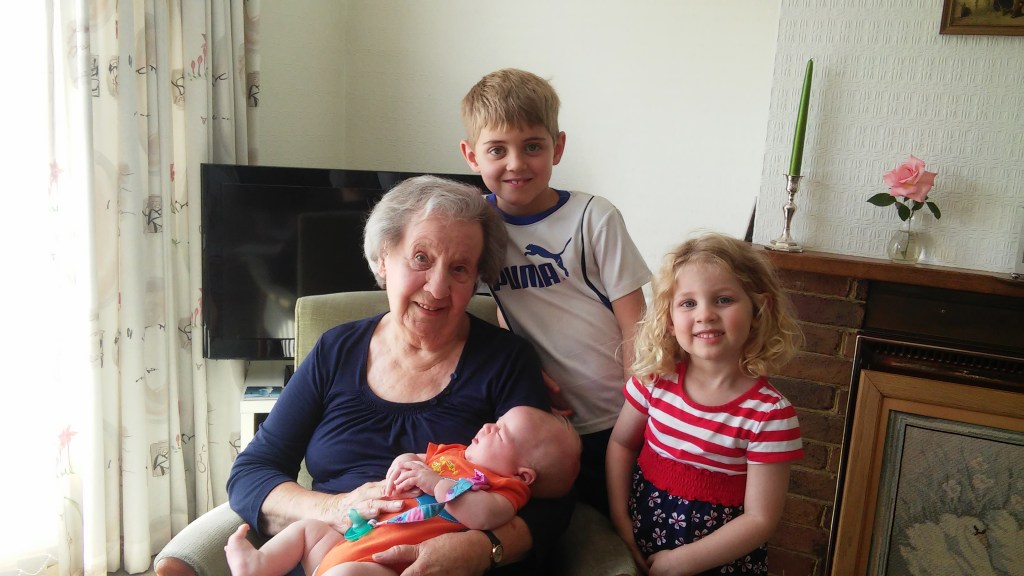
Ben’s grandmother, Elsie Hammond, died on Tuesday. She was 97 years old. Last fall, she suffered a stroke from which she never recovered so she spent her last weeks and days (or so we were given to understand) unaware of her surroundings and mostly unresponsive. Death was therefore something of a relief and a release.
But not without consequence. Since 2016, Great-Gran, as my kids knew her, has been the last and only living great-grandparent they had. And it’s not like they had just a passing relationship with her, even though she lived across an ocean. Whenever we visited England we would always try to find a way to see her. And she always welcomed us. So her loss is felt and known in our little family and she will be missed.
Before the stroke, Great-Gran was pretty unstoppable. Indeed, the joke was that she would likely outlive us all. She lived entirely independently and had no mental or physical ailments to speak of. She had a real, vibrant life – before she didn’t anymore. It was a life she felt entirely comfortable and confident in.
But the one thing I remember her best for, the one story I want to tell about Elsie is about the time she showed me hospitality.
I had met and interacted with Elsie sporadically over the years; she was at our wedding, of course, and, as I say, we would often visit her on our trips to England. We even stayed a few nights during one particularly memorable visit when we got snowed in with her.
Elsie lived in a 2-bedroom, second-story flat with a lovely view of the gardens below, not far from Eastbourne, where Ben grew up.
Once, we stopped by her apartment for an extended lunch on the way to or from some place else. As she was laying the table with “bits and pieces” – ham and cheeses, breads and pates and sausage rolls [side note: surprisingly, English food is the best for this kind of smorgasbord lunch; I know, you’re thinking surely the French or the Spaniards with their tapas do it better, but you’re wrong. I’m telling you, you’re wrong.] – I was wandering a bit around her living area, looking at the pictures of her grandkids and great-grandkids, checking out her knickknacks. We’d visited enough over the years that I was accustomed to the space but not enough that it felt familiar yet.
I came across two decorative plates on the shelves in her dining room, displayed on little stands \ made for the purpose. Colorful pictures of flowers and vines and greenery covered them with a little pattern of smaller dainty blossoms around the edges. There was a butterfly featured on one and something like a peacock on the other. And everything was outlined with this lovely gold filament.
I’m sure I asked Great-Gran about the plates and I’m sure she told me the story behind them – where she got them, why she kept them. But I honestly don’t remember even the slightest bit about that story. I do know that they struck me as curiously beautiful, something just plain pretty that served no other purpose than to be pretty. And they delighted me.
Fast-forward a year, maybe two, before we made it back to Elsie’s home for another visit. Ben and I got the kids (there were two of them by this time) settled down and Elsie was puttering around in the kitchen getting another lunch ready for us. She called out to us in the other room, in an off-hand sort of way: “I put Leyla’s name on those plates she liked,” she said. “Take them now if you have room in your luggage or keep them here if you like and you can get them another time.”
I looked at Ben bewildered. “What is she saying?” I asked him, sotto voce.
“I think she’s talking about those decorative plates on the shelf over there,” he said, pointing in their general direction.
I went over and looked at them again. So curious, so pretty. Ben came up beside me. “I bet she put a sticky-note with your name on it on the back,” he said. “She would do that for us sometimes. When there was something she wanted me or Vicky to have, she’d set it aside with our names on it so that she wouldn’t forget to give it to us.”
I just sort of looked at Ben for a moment and then, gingerly, I reached out and picked up one of the plates, lifted it from its stand and turned it over. It was like that scene from Willy Wonka and the Chocolate Factory when Charlie peeks under the wrapper of the chocolate bar and sees the glint of that golden ticket. Sure enough, there on the back of the plate was a yellow post-it and in black sharpie, one word in Great-Gran’s elegant handwriting: “Leyla.” I set it back down and picked up its twin to find a twin post-it, a twin of my own name.
Let me be clear about something: Ben and I are married. Elsie is Ben’s grandmother, not mine. And, by this time, I had a daughter, Elsie’s great-granddaughter. If Elsie just wanted to hand down those little plates in the family, like an heirloom, she could have done so and we would have received them as a beautiful gift. If she had wanted to, Elsie could have written one of probably a hundred permutations and combinations of names on those post-its. She could have labeled them for “the Kings” or “Beatrice,” “Ben & Leyla” or “Ben’s kids.” But she didn’t choose any of those. She chose to write my name on them. She purposefully set them aside and marked them as mine alone. She gifted those delightful things to me, just me.
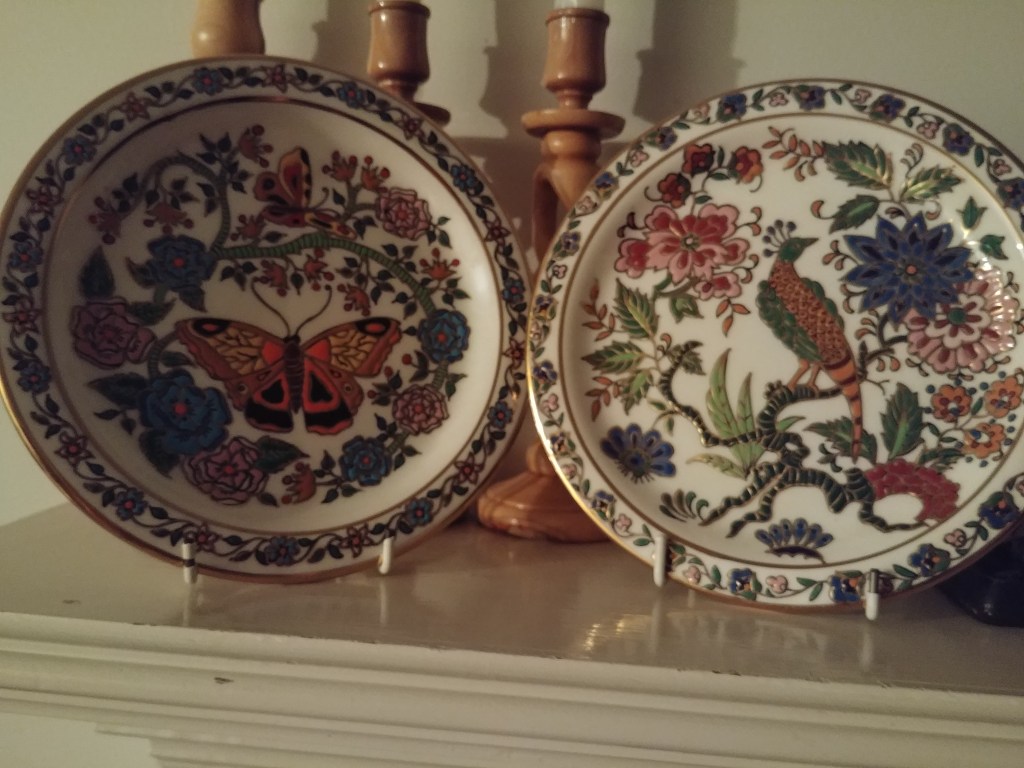
Today, the plates sit in a place of pride on our mantle at home in Sewanee. Every time I pass them, I think of Great-Gran and am reminded of her gracious hospitality to me.
Hospitality is mentioned so often in our Scriptures, held up as a core value of what it looks like to be of God’s people:
“Do not neglect to show hospitality to strangers, for by doing that some have entertained angels without knowing it.” – Hebrews 13:2
“Above all, maintain constant love for one another, for love covers a multitude of sins. Be hospitable to one another without complaining.” – 1 Peter 4:8-9
“For a bishop […] must be hospitable, a lover of goodness, prudent, upright, devout, and self-controlled.” – Titus 1:7-8
And that’s just a bare smattering. But, of course, Jesus says it best:
“For I was hungry and you gave me food, I was thirsty and you gave me something to drink, I was a stranger and you welcomed me, I was naked and you gave me clothing, I was sick and you took care of me, I was in prison and you visited me.” – Matthew 25:35-36
In its essence, hospitality is about so much more than just opening your door to someone, so much more than spreading a meal before them. As a reflection of the divine being, human hospitality is opening oneself and one’s spaces up to all who knock. It’s about acting to make the naked one feel clothed, the hungry one feel satisfied, the hurt one feel whole and the one who feels out-of-place, the stranger, feel as though she has arrived, unexpectedly, at home among those who love her.
And sometimes, showing that kind of hospitality is as simple as a name on a post-it note (or two). Sometimes, hospitality is a small gesture that says, Here is my gift to you; what once was mine belongs now with you and thus you belong with me.
In Arabic, when you invite someone into your home, you say ahlan wa sahlan. On a basic level, it’s just a translation of “welcome” or maybe “come on in.” But its roots are much more interesting. “Ahl” has a basic meaning of “family” or “tribe” and “sahl” carries a sense of ease or plain-going. My grandmother once told me that ahlan wa sahlan is a sort of short-hand way of speaking true hospitality, for it really means “May my family be to you like your family and may the road between us be smooth and easy.”
Some years ago, Elsie Hammond wrote my name on two post-it notes on the back of two decorative plates and I knew I was part of her family.
May you rest in peace and rise in glory, Great-Gran. The Lord bless you and keep you. The Lord make his face to shine upon you and be gracious unto you. The Lord lift up his countenance upon you and give you peace.
And may you be welcomed into the fullness of God’s love in the same way you once welcomed me. Amen.

 The Thankful Priest - Leyla King
Leave a comment